
Sculptra vs. Dermal Fillers
A complete, no-fluff guide to understanding the difference between Sculptra and traditional fillers — written for Triangle NC patients.
Walk into almost any aesthetic practice in Raleigh, Durham, or Chapel Hill and you'll likely hear two names come up when discussing facial volume: Sculptra and dermal fillers. Both are injectable treatments that address volume loss and signs of aging — but they work in fundamentally different ways, deliver results on very different timelines, and tend to serve different goals.
We'll break down the science, the results, the average cost, and the ideal candidate profile for each treatment and explore why many providers here in the Triangle and we at Refinery Aesthetics & Wellness are recommending a combined approach.
Sculptra: The Collagen Stimulator
Sculptra is an FDA-approved injectable made from poly-L-lactic acid (PLLA) — a biocompatible, biodegradable synthetic material that has long been used in medical sutures. Unlike most injectables that add volume directly, Sculptra works by triggering your body's own collagen production.
When injected into the deeper layers of the dermis, the PLLA microparticles gradually dissolve and, in doing so, stimulate fibroblasts to produce new collagen. The product itself fades as your body replaces it with fresh structural support, so improvements build subtly over several months rather than appearing overnight.
"Sculptra doesn't just fill your face — it rebuilds the scaffolding underneath it. For patients in the Triangle dealing with significant volume loss or skin laxity, that distinction matters enormously."
What to Expect with Sculptra
Sculptra is a series-based treatment, meaning most patients require 2-3 sessions spaced 4-6 weeks apart. Early changes may be noticeable within a few weeks, but peak results typically develop at the three-to-six-month mark, as collagen production accelerates. Results can last two to four years — significantly longer than most traditional fillers.
Because Sculptra is injected in liquid form (rather than a gel), it spreads more diffusely, making it ideal for broad structural zones rather than precise, targeted corrections.
Traditional Dermal Fillers: Instant Volume
Traditional dermal fillers are gel-like substances injected beneath the skin to immediately restore lost volume, smooth lines, and enhance facial contours. Most are made from hyaluronic acid (HA) — a naturally occurring substance in the body that attracts and retains water — which gives skin a hydrated, supple appearance from the moment of injection.
Common HA filler brands available at Triangle-area practices include Juvederm, Restylane, Versa, and RHA, Evolysse.
What to Expect with Dermal Fillers
Results are visible immediately after treatment. A typical filler appointment takes 30 minutes or less, with minimal downtime — some mild swelling or bruising is common but usually resolves within a few days. Most HA fillers last 6 to 12 months depending on the product, the treatment area, and individual metabolism. Crucially, HA fillers are reversible: an enzyme called hyaluronidase can dissolve them if needed, making fillers an appealing option for first-time injectable patients.
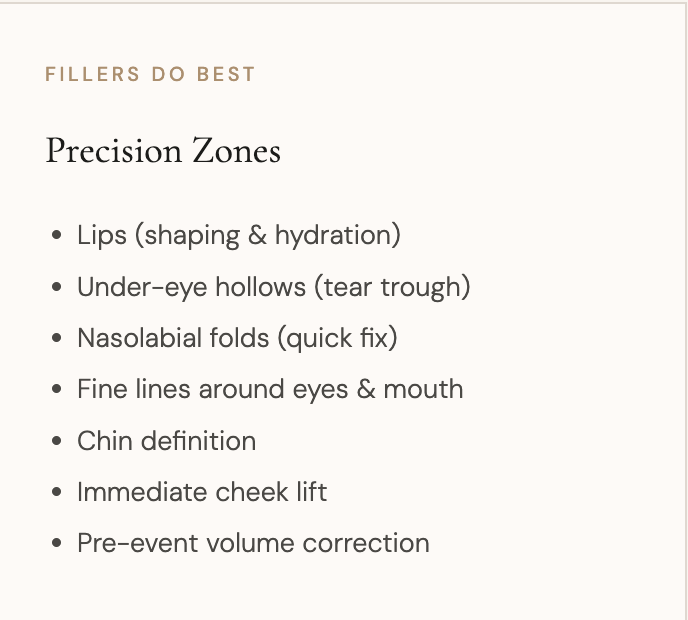
Where Each Treatment Shines
One of the most practical ways to choose between Sculptra and traditional fillers is to consider where you'd like to see improvement. Each treatment has areas where it consistently delivers exceptional outcomes.

Who Is Each Treatment Right For?
You May Be a Great Sculptra Candidate If…
You want long-lasting results
You're comfortable with a gradual reveal
You have volume loss across broad areas
You've experienced facial sagging from weight loss
You're concerned about skin quality, not just volume
You prefer results that look natural over time
You May Be a Great Filler Candidate If…
You want immediate, same-day results
You're treating a specific, targeted area
You have an upcoming event
You want lip enhancement (Sculptra is not for lips)
You have adequate natural collagen
Cost Considerations: Pricing in Cary, Raleigh, Durham & Chapel Hill
Cost is naturally a significant factor for Triangle-area patients comparing these treatments. Here's a realistic picture of what to expect in the local market.
Sculptra typically runs $700–$1,000 or more per vial at Raleigh-Durham area practices, and most patients require multiple vials across two to three treatment sessions for optimal results. This means the initial investment can be $2,500–$5,400+ for a full Sculptra series.
Traditional HA fillers generally range from $700–$800 per syringe at Triangle-area providers. Many lip treatments require one syringe; cheek or jawline work may need two to three. Touch-ups every 6–12 months add to the ongoing cost.
The Combined Approach of Sculptra + Fillers: The Best of Both
Here's a truth many Triangle patients discover after their first consultation: the choice between Sculptra and fillers doesn't have to be either/or. A growing number of aesthetic providers in the Raleigh-Durham area recommend a blended protocol that leverages the strengths of each treatment.
The logic is straightforward: Sculptra rebuilds the deep structural foundation of the face over time — lifting the mid-face, restoring temple volume, improving overall skin quality. Meanwhile, traditional fillers can address specific areas that need immediate precision: softening nasolabial folds, sharpening the jawline, or plumping the lips before a special occasion.
Some providers pair both treatments with neurotoxins like Botox or Dysport to address dynamic wrinkles on the forehead and around the eyes, creating a comprehensive, coordinated plan that targets skin quality, shape, and movement — all at once.
This combined strategy is particularly popular among Triangle patients in their 30s -50s who want results that look genuinely refreshed rather than obviously treated.
Ready to Find the Right Treatment for You?
The best way to know whether Sculptra, fillers, or a combination is right for you is a one-on-one consultation with a qualified aesthetic provider.