

Body contouring with biostimulators
Beyond fillers and surgery — biostimulators are reshaping how we think about fat, skin laxity, and long-term body sculpting.
Injectable biostimulators (i.e. Sculptra + Hyperdilute Radiesse) represent one of the most significant shifts in body aesthetics in years. Unlike traditional fillers which add volume by occupying space, biostimulators work by triggering your own biology to rebuild from within. The results are subtler, longer-lasting, and increasingly, the preferred approach for patients who want real improvement without the recovery of surgery.
What are biostimulators?
Biostimulators are injectable substances that stimulate the body's natural collagen and elastin production, gradually improving skin quality, laxity, and volume where it counts. They don't replace lost fat or tissue, they prompt the skin and subcutaneous layer to regenerate and restructure over time.
For the body specifically, they're particularly valuable in areas where skin laxity follows weight loss, aging, or hormonal change: the arms, abdomen, inner thighs, buttocks, and décolletage (places where traditional body fillers were either impractical or simply unavailable).
“Key distinction— Biostimulators are not volumizers. They don’t create an immediate change in shape the way hyaluronic acid fillers do. What they create is a biological process, collagen neogenesis, that unfolds over weeks and months, producing results that are genuinely structural rather than cosmetic.”
The main agents used for body contouring
Several biostimulatory substances have emerged as the leading options for off-face and body applications, each with a distinct mechanism and ideal use case.
Sculptra (Poly-L-lactic acid)
The most established body biostimulator. Stimulates collagen via a mild inflammatory response. Ideal for the buttocks, hips, and abdomen. Results develop over 3–6 months.
Hyperdilute Radiesse (Calcium hydroxylapatite)
Provides immediate structure while stimulating collagen. Well-suited for arm laxity, the chest, and areas needing firming. Can be diluted for broader skin quality improvement.
What can biostimulators actually treat on the body?
The range of body applications has expanded considerably as injectors have developed more refined techniques. The most evidence-backed uses include:
The buttocks and hip dip area — perhaps the most popular body biostimulator treatment globally — using PLLA to add subtle volume and lift without implants or fat transfer. The inner arms, where laxity responds well to CaHA for tightening. The abdomen and flanks, especially in patients who've experienced skin loosening post-weight loss. The knees and inner thighs, which are notoriously difficult to treat surgically but respond to collagen stimulation over time. And increasingly, the décolletage and chest, where skin crepiness is a persistent concern.
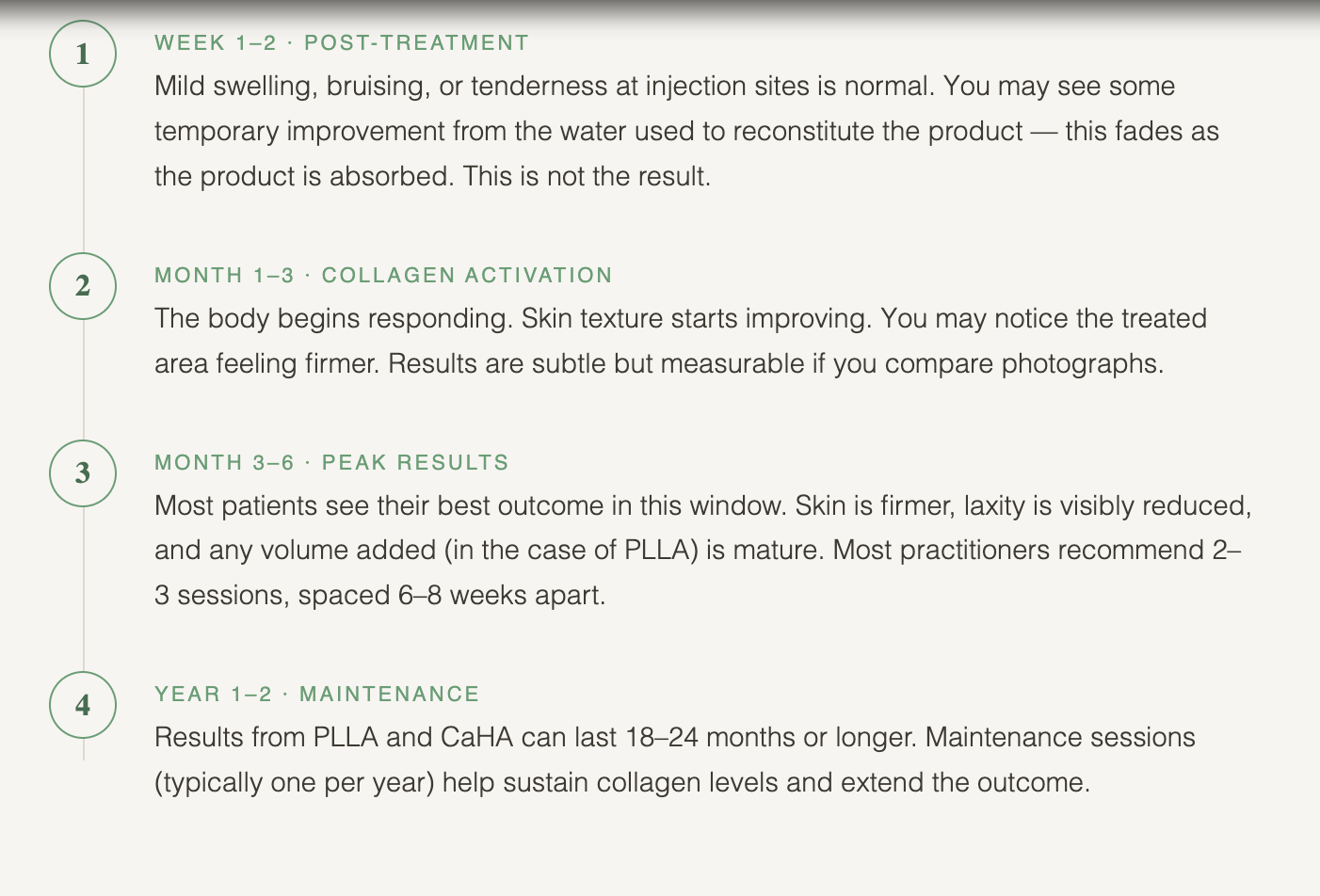
The treatment timeline: what to expect
Managing expectations is where patient education matters most. Biostimulators are a process, not an event.
Who's a good candidate — and who isn't
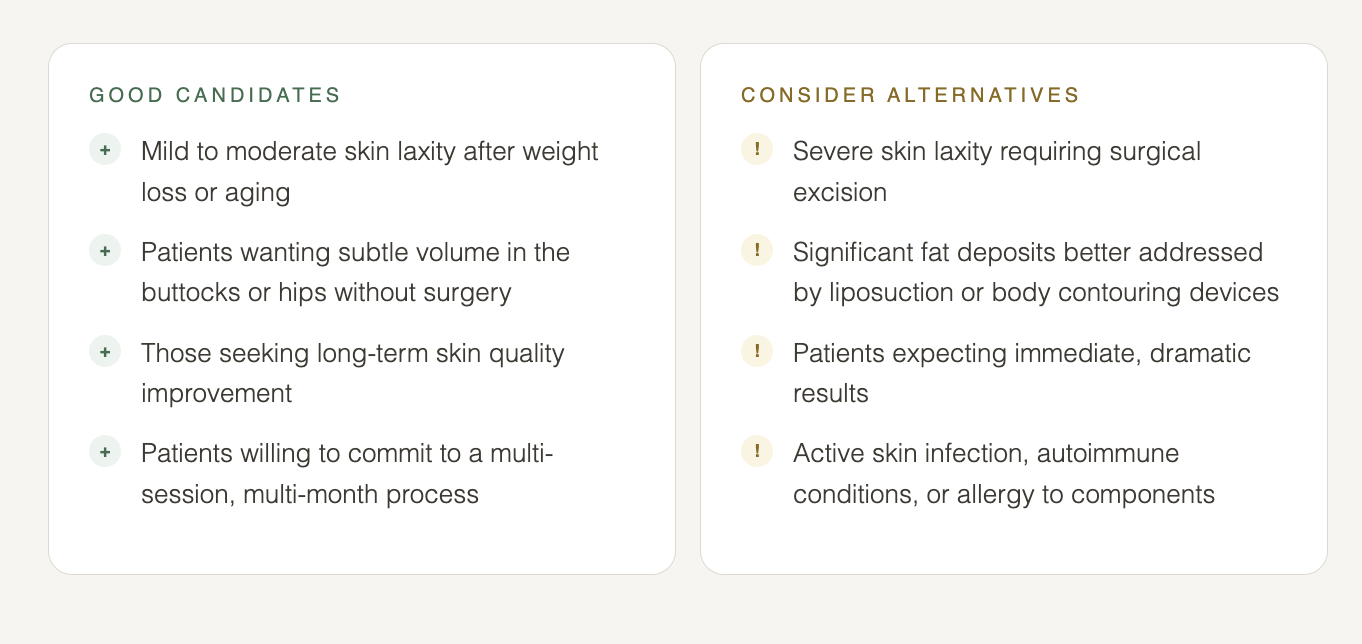
Biostimulators work best for patients with mild to moderate laxity or volume loss who are looking for gradual, natural-looking improvement. They're not a replacement for surgical lifting or significant fat reduction — but for the right patient, they fill a gap that nothing else quite does.
Safety, side effects, and choosing a provider
Biostimulators have strong safety profiles when administered by trained, experienced injectors. The most commonly reported side effects — bruising, tenderness, and temporary nodules — are generally mild and resolve on their own. Rare but more serious risks include papules or nodules if the product is placed too superficially, particularly with PLLA in thin-skinned areas.
The critical variable is provider selection. Body biostimulator injections require a thorough understanding of anatomy, dilution ratios, injection planes, and patient selection. This is not a treatment that translates directly from facial injecting experience — body tissue behaves differently, and technique matters enormously.
“What to ask your provider
How many body biostimulator treatments have you performed? What dilution protocol do you use, and why? What results can I realistically expect given my skin quality and body composition? The answers tell you a great deal about whether you’re in the right hands.”
How biostimulators fit into a broader body plan
The most effective body contouring outcomes today tend to combine modalities. Biostimulators pair well with energy-based devices like radiofrequency microneedling (Morpheus8, Emtone) or focused ultrasound for skin tightening. They can complement fat reduction treatments like CoolSculpting or Kybella. And for patients who've undergone weight loss — surgical or otherwise — they address the residual skin quality issues that fat reduction alone can't fix.
Thinking of biostimulators as one tool in a broader strategy, rather than a standalone solution, tends to yield the best outcomes. A good injector will help you understand where they fit — and where they don't.
Biostimulators won't replace surgery for everyone. But for the growing number of patients who want meaningful, lasting improvement without downtime, they represent something the aesthetic world has needed for a long time: a bridge between doing nothing and doing everything.